
Getting Fayette County Court Records
Sheila Studdard is the elected Clerk of Superior, State and Magistrate Courts. She keeps the files for those three Fayette County courts. Give her office the court. Give the case number if you have it, plus the filed year, a party or defendant name, and the exact document. The Clerk's online docket is a good index to start from. Treat it as one route among several, since the direct endpoint can throw an internal-error message. You can also inspect records at public terminals at the Fayette Justice Center. Supervised file review is another option there, open 9 a.m. to 5 p.m.
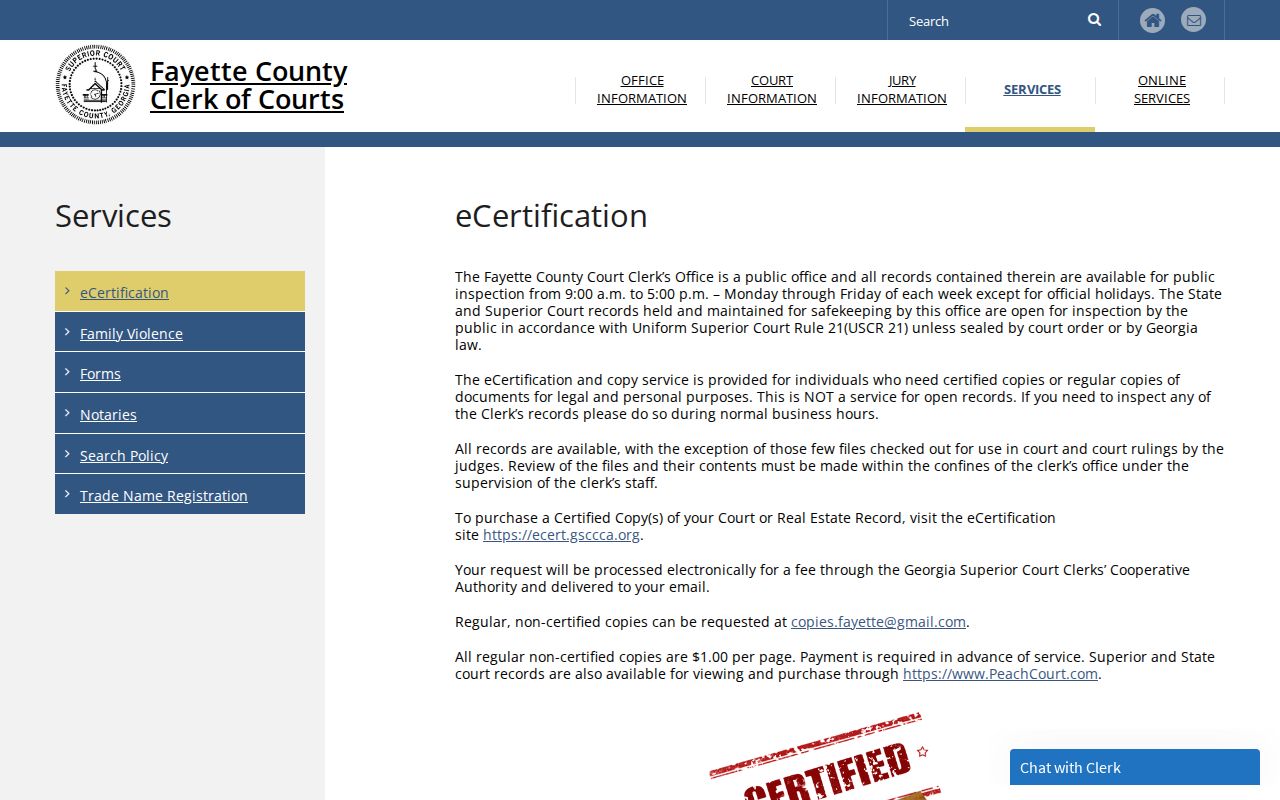
Plain copies go through the civil or criminal form by mail. The Clerk takes regular non-certified requests at copies.fayette@gmail.com. Phone lines split by function: 770-716-4290 for the main office, 770-716-4294 for State civil, 770-716-4293 for State criminal, and 770-716-4292 for State traffic. PeachCourt can supply file-stamped documents for a participating court. For certified electronic copies, GSCCCA eCertification is the route. Probate, Juvenile, municipal, and federal records each sit with a separate office.
- Identify the court, case, filed year, and exact record.
- Choose inspection, a plain copy, a filed image, or certification.
- Use the docket, terminal, counter, phone, mail, email, PeachCourt, or eCertification.
- Wait for a quote and pay through an accepted method.
- Compare the delivered record with the case and document requested.
Fayette County Record Terminal Access
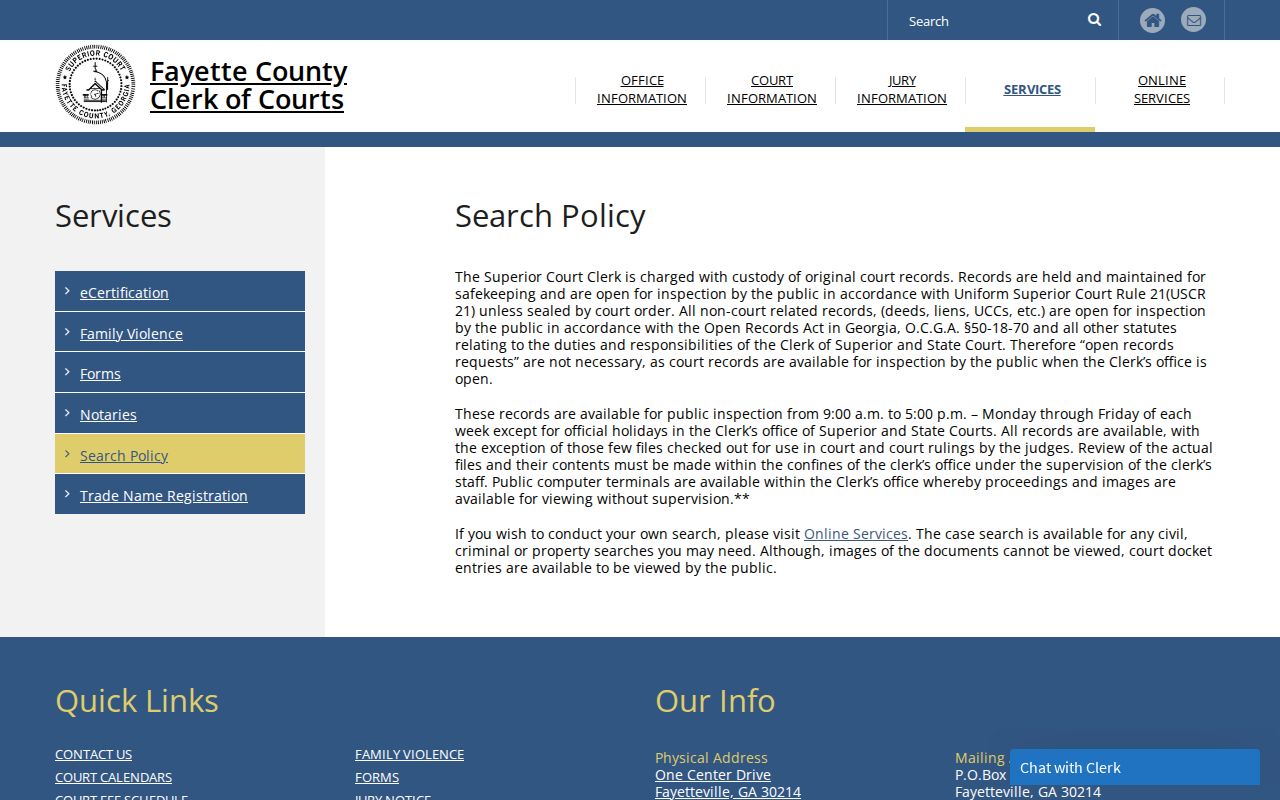
A public terminal often shows more than the web docket does. Under the Clerk's policy, Superior and State docket entries appear online. Images are left out of that basic county view, though. Come to the courthouse and a terminal lets you inspect proceedings and images. Physical files stay under supervision. A file pulled for court or for a ruling may be out for a while. Yet it remains public the whole time.
If a file is checked out, ask when it should return. A missing terminal result is no reason to send a generic Open Records Act request. The Clerk's official Search Policy spells out inspection hours, terminal use, and local limits.
Court Record Types
Magistrate Court handles its own slice of the Fayette County docket. That slice covers civil claims, garnishments, dispossessory matters, abandoned-vehicle cases, personal-property foreclosures, and warrant applications within its authority. Civil request forms reach much wider ground, though. They cover lawsuits, divorce, child support, name changes, service papers, complaints, answers, agreements, temporary orders, protective orders, judgments, decrees, and worksheets. On the criminal side, the forms cover accusations, indictments, final dispositions, and other named documents.
Other records live in other hands. Probate Court keeps its own clerk for estates, wills, guardianships, marriage, weapons, and vital records. Land records demand care too. The Clerk may hold deeds, plats, UCCs, liens, and property indexes. None of those form a court case docket, though. Anything filed in federal court belongs to PACER and CM/ECF, not to the Fayette County state-court file.
- Docket sheets and chronological case entries
- Civil pleadings, motions, orders, and judgments
- Criminal accusations, indictments, sentences, and dispositions
- Magistrate case papers and final orders
- Separate Probate case and vital-record categories
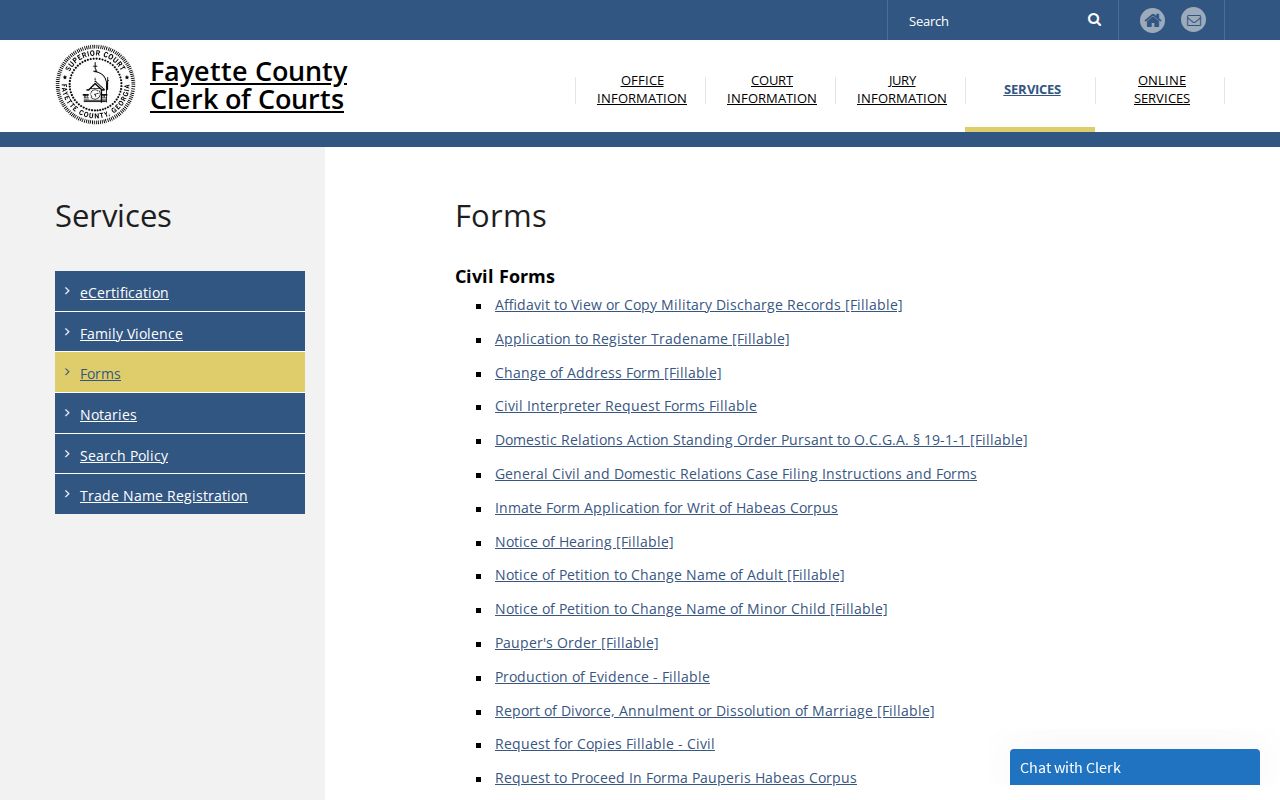
Want to see the actual paperwork? The Clerk's official forms directory displays the civil, criminal, Magistrate, and domestic forms a person uses to request specific Fayette County records.
Three Fayette County Record Layers
Three different products often get lumped together in a Fayette County case lookup. First comes the docket itself, which is simply the register. It lists the case number, caption, court, dates, status, events, and any setting. Second is a filed document. That is the actual text of a complaint, petition, answer, motion, order, decree, accusation, indictment, or disposition. The county's basic docket stops short of showing those images.
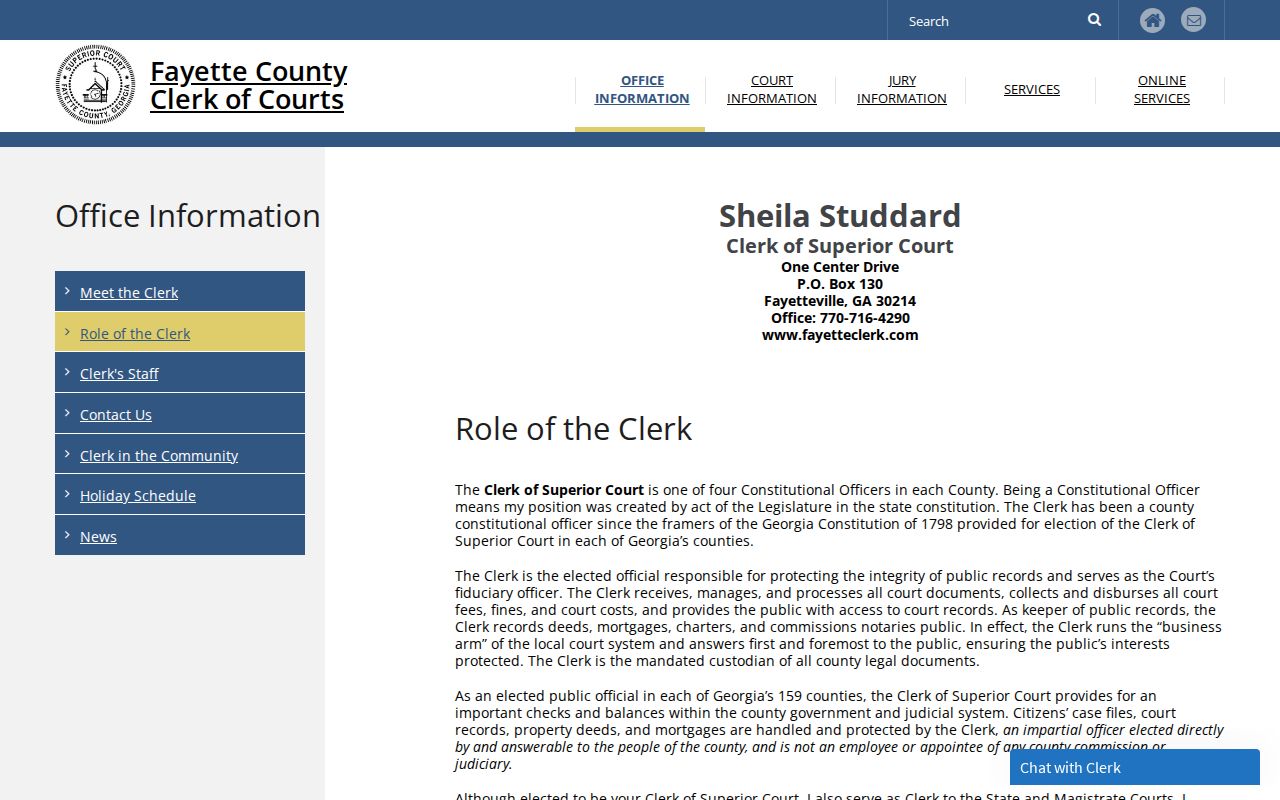
Third is the certified copy. The Clerk processes it and attaches official authentication. That is what courts, agencies, and other formal recipients demand as proof. One caution applies here. Viewing an image at a terminal, or buying it through PeachCourt, does not make it certified. The source being official is not enough. For the office's part in all this, the Clerk's custodian description explains how the office maintains case records and prepares appeals.
Inside a Fayette County Court Record
Open a Fayette County case file. You may find the case number, caption, party roles, filed date, case category, pleadings, motions, orders, settings, and disposition. The official calendar PDFs add context: judge, calendar type, hearing date, time, courtroom, cause, and event note. Read a calendar line with care, though. It records a setting and nothing more. A listed hearing date is not proof the hearing took place. Nor is it proof that the judge entered a ruling. Civil calendars have shown the label OP, but no official source defines what it means.
| Case Number | The clerk identifier and filed year, preserving all letters, dashes, and suffixes. |
|---|---|
| Pleadings | Complaints, petitions, answers, motions, accusations, or indictments filed in the case. |
| Orders & Judgments | Signed rulings, decrees, sentences, dispositions, and final orders. |
| Docket Sheet | The dated sequence of filings, settings, orders, and procedural events. |
| Calendar Data | Judge, date, time, courtroom, setting type, and event note when scheduled. |
Abbreviations on a docket can look like code. Ask the Clerk of Court to explain any status term you do not recognize. A Fayette County civil case number might look like 2023V-0741-C1, though criminal, municipal, and Probate cases use their own numbering, so copy the case number exactly as the court record shows it.
Fayette County Court Record Forms
Start with the copy request forms. They show exactly what the records desk wants from you. Whether you use the civil form or the criminal one, be ready to give a case number if you have it. Add the case year, the parties' names, the document you need, and how many copies. Both forms also ask for your contact details and how you want the record returned. The criminal version adds two search aids: the charge and the defendant's date of birth. That birth date goes in a private request field. It is not permission to publish it.
Mail your request to the Clerk of Superior Court, attention Court Records or Criminal Records, Fayette Justice Center, One Center Drive, Fayetteville, GA 30214. Phone card payment is an option after processing, with Discover, MasterCard, or Visa. If you pay by mail, use a business check, money order, or cashier's check. Neither form promises a turnaround time, and neither lists a staff search fee. Certified and expunged copies cannot come back through ordinary email. The Clerk's official profile also covers e-filing duties and the Judicial Data Exchange.
Fees and Certified Copies
A plain copy just reproduces the record. Certification is different: the Clerk adds official authentication. Fayette County handles electronic certified requests through GSCCCC eCertification, which covers checkout and delivery too. Regular non-certified email copies cost $1 per page with advance payment, per the county page. The July 1, 2024 fee schedule lists several other categories, so the total depends on the service and whether staff help is required.
| Item | Published Amount |
|---|---|
| Unassisted uncertified copy | $0.50 per page |
| Assistance-required uncertified copy | $1 per page |
| Certified copy | $0.50 per page |
| Certification or exemplification seal | $2.50 |
| Computer printout | $2.50 per page |
| Electronic copy | $2.50 first page, then $0.50 each added page |
The county posts no general public-inspection fee and no staff search fee. Ask the records desk which category fits your request. Wait for a quote before paying. The Clerk's eCertification page spells out the difference between ordinary copies and certified electronic service.
Fayette County Court Records
Fayette Justice Center
One Center Drive, Fayetteville, GA 30214
770-716-4290
Fayette County Court Record E-Filing
Electronic filing splits along the same lines as the records themselves. PeachCourt serves participating Superior and State courts for civil or criminal e-filing and document access. Real-estate and UCC filings run through GSCCCA eFile instead. Probate work belongs to the public modules at Georgia Probate Records. Each system handles electronic documents. But that similarity can mislead a filer into the wrong service. The Georgia Courts e-filing directory lists each provider and whether filing is mandatory.
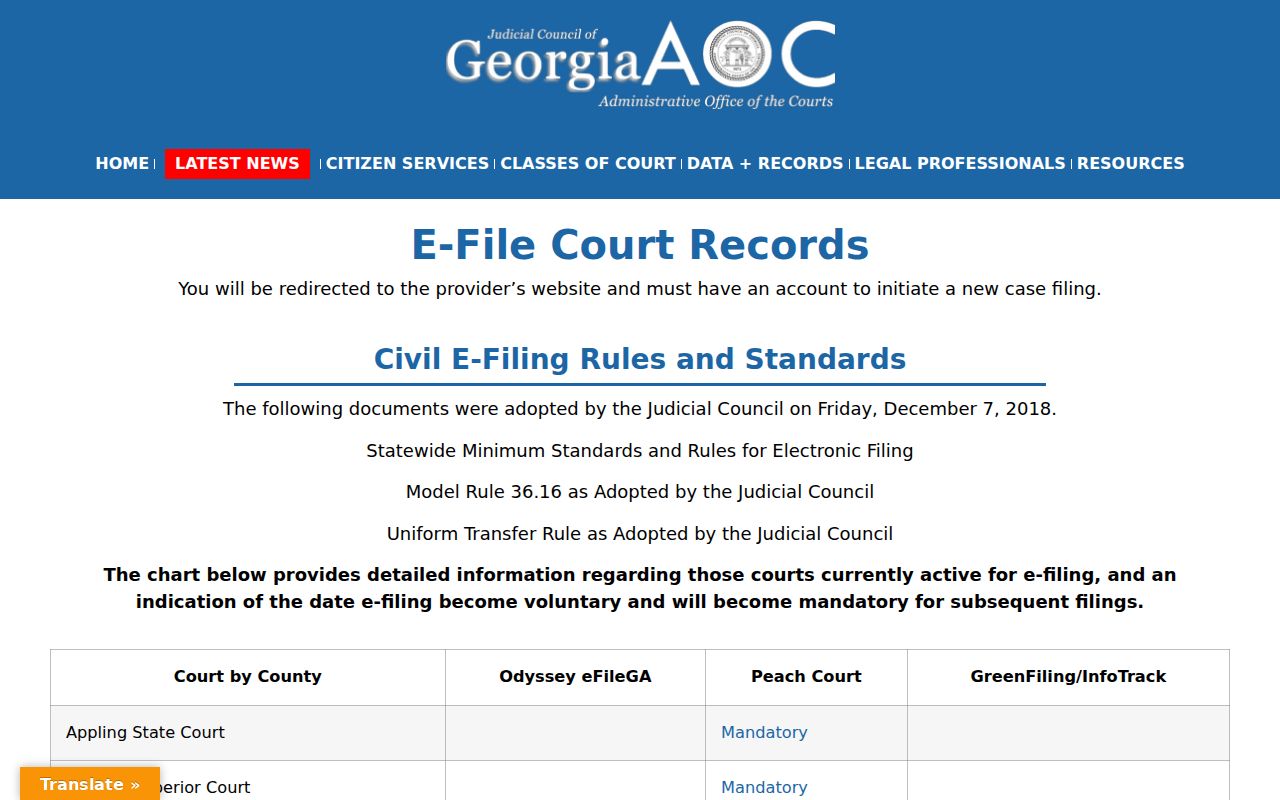
Registering with PeachCourt costs nothing. Document access and charges, though, depend on the participating court and the record you want. PeachCourt is not a statewide search box for Fayette County cases. A known local case still belongs on the Fayette County docket. Check it with the responsible clerk.
Sealed Records and Public Access
Uniform Superior Court Rule 21 starts from open access. Fayette County Superior and State court records are presumed public unless a statute or court order says otherwise. Any limit must state its scope and duration, and it must weigh harm from disclosure against the public interest. Restrictions can be temporary and reviewed later. Rule 21.6 and O.C.G.A. §9-11-7.1 govern protected identifiers and remote-access limits. Some juvenile records can be sealed under O.C.G.A. §15-11-701.
Key access rules: Uniform Superior Court Rule 21 governs inspection, restriction, review, and redaction. O.C.G.A. §9-11-7.1 limits personal identifiers in civil filings. O.C.G.A. §15-11-701 addresses sealing for certain juvenile matters.
A missing image or empty search result proves nothing. The file may be checked out, sealed, expunged, redacted, held by another court, or viewable only at a terminal in the Clerk's office. Ask the Clerk which of these applies. If access is restricted, ask which order or law controls, and whether a redacted copy or an authorized-requester route exists.
Fayette Court Files and ORA
Do not assume a court-file request is an Open Records Act request. Under the Attorney General's explanation, Superior, State, Probate, and Magistrate courts are not agencies subject to the Act the way county departments are. Access to court files follows clerk inspection rules, court rules, statutes, and judicial orders instead. Non-court records are a separate matter. Sheriff's reports, budgets, contracts, and administrative correspondence belong to the agency that holds them, under O.C.G.A. §50-18-70 et seq.
This boundary saves time. A request for a complaint, order, indictment, or disposition goes to the clerk keeping the case. A request for an executive-agency document goes to that agency. The county docket helps you sort the first category out. It does not turn every record touching a lawsuit into part of the court file.