
Searching Fayette County Civil Dockets
Begin at the Clerk's Online Services page and open its Court Docket link, which covers Superior, State, and Magistrate entries when the service responds. The link does fail at times. Before searching, gather the party name, the likely filing year, the case type, and any number printed on a summons or notice. A known case number beats a name search, since common names can return several possible matches in the civil docket.
The court matters as much as the name. Superior Court holds domestic relations and broad civil matters. State Court shares that civil jurisdiction except where Superior Court alone controls a subject. Magistrate Court takes smaller claims and listed summary matters. Then follow these steps:
- Identify the court from the notice or case type.
- Try the county Court Docket link by name or number.
- Confirm the style, filed year, status, and assigned judge.
- Compare the next event with the current judge calendar.
- Request the actual filing or certified judgment from the clerk.
PeachCourt provides account-based access for participating Superior and State courts. It can show file-stamped documents, but access varies, and the clerk remains the answer for an older, checked-out, or certified court file.
Fayette Civil Desk Fallbacks
A failed portal search means reroute, not give up. The State Court civil desk answers at 770-716-4294. The main Clerk line at 770-716-4290 handles Superior and Magistrate record questions, and the Superior Court office at 770-716-4280 can help with a judge-specific setting. At One Center Drive, public terminals and supervised review run from 9 a.m. to 5 p.m. One catch: a file may be checked out to a judge or courtroom. Then it is briefly out of reach.
For copies, mail the official civil copy form to Court Records. It asks for the parties, case number, case year, document type, quantity, requester contact data, and return method. The clerk takes card payment by phone, and mailed requests can use a business check, money order, or cashier's check.
Best fallback: Use the number on the court notice when calling. Ask whether the file is in Superior, State, or Magistrate Court and whether it is checked out.
Inside a Fayette County Civil Docket
Fayette calendar records carry a lot of local detail. A single civil row can show the case number, style, status, type, filed date, cause, setting time, party roles, service and answer dates, attorney role and phone, setting note, judge, court, courtroom, and the date the calendar was generated. The example 2023V-0741-C1 comes from a real calendar, but the county publishes no format guide, so do not apply its suffix to every case number you meet.
| Case and style | The local case number and names used to identify the action. |
|---|---|
| Type and cause | The category, such as contract, divorce, name change, support, or TPO. |
| Service and answer | Dates that may show notice and a response, not a merits decision. |
| Setting | Date, time, judge, courtroom, and setting note for the next event. |
| Status and filings | Procedural status and chronological references to documents or orders. |
A docket line only points to an event. The complaint, agreement, temporary order, final judgment, or decree is a separate document from the entry.
Fayette Civil Assignment Orders
The Clerk's Local Orders page publishes assignment orders and amendments affecting both civil and criminal court work in Fayette County.
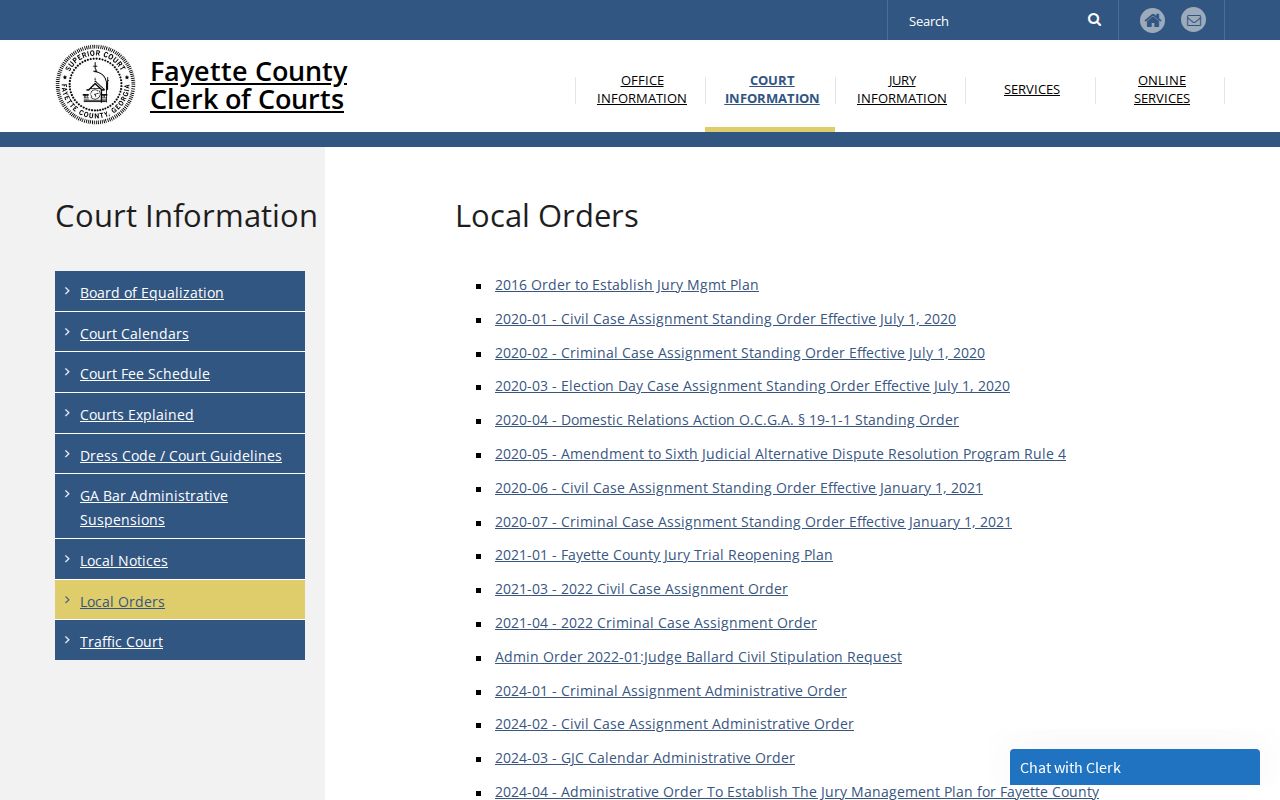
Assignment orders explain why a matter sits under a particular judge. Read them with the case docket and the current calendar. An administrative assignment is not a ruling. Judge pages also separate motions, special sets, jury settings, and other hearing types, which makes them a stronger date check than assuming every civil matter lands on one master list.
Civil Case Types on the Docket
Case type drives both the court and the vocabulary on Fayette County civil dockets. Superior Court handles the big categories. Divorce, domestic relations, temporary protective orders, child support, name changes, personal suits, and other broad civil matters all sit there. State Court lists its own share. There you find tort and personal injury matters, contract disputes, appeals from Magistrate Court, garnishments, dispossessory actions, and personal property foreclosures.
- Domestic relations, divorce, support, and related orders
- Contracts, accounts, torts, and personal injury disputes
- Garnishments and dispossessory proceedings
- Name changes and temporary protective order matters
- Magistrate appeals and personal property foreclosures
Magistrate Court caps civil claims at $15,000. It also hears garnishments and other listed proceedings. An appeal or transfer opens a new trail in State or Superior Court, so write down both case numbers and both courts.
Fayette Civil Documents by Name
The Clerk's copy form doubles as a checklist of what sits behind a Fayette County civil docket. It lists a civil lawsuit or garnishment, divorce, child support, name change, service, final judgment and decree, final order, answer, judgment, agreement, child support order through divorce, temporary order, income deduction order, TPO, complaint, and worksheet. Those names are worth learning before you request court records.
| Need | Ask for |
|---|---|
| How the action began | Complaint, petition, or other initiating filing |
| Whether a party responded | Answer and service records |
| Temporary direction | Temporary order, TPO, or income deduction order |
| Final result | Final order, judgment, or decree |
If you need paperwork that a court will accept, the Clerk handles certified copies through its copy and eCertification procedures. A Fayette County civil docket printout does not count as certified.
Civil Docket Settings and Hearings
Civil settings are organized by judge and hearing type. Fayette sorts these into categories. They include divorce or annulment, contempt, contract account, name change, support-IV-D, TPO, pro se, and child support. One local special-set calendar uses the phrase “SPECIAL SET TEMPORARY HEARING.” That phrase describes a scheduled temporary hearing, not a final judgment.
- Special set
- A matter assigned a specific hearing slot rather than a general calendar call.
- Pro se
- A party who appears without a lawyer.
- TPO
- A temporary protective order category that may include urgent hearings.
- Setting
- A scheduled court event; it does not state the outcome.
Read status text with care. The Clerk does not define the code “OP,” so treat it as an unexplained label, not a disposition. When a code is unclear, call the civil desk.
Civil Docket Access Rules
The Clerk's Search Policy rests on Uniform Superior Court Rule 21. Under that rule, Fayette County case files are open to inspection. A statute or court order must say otherwise. Remote docket access can show less than a terminal search or a supervised paper file. Protected identifiers get redacted. A checked-out file may sit out of reach briefly. Those limits come with the territory, not with any secrecy about the file itself.
Georgia's Open Records Act works differently. It governs non-court agency material. Requests go through the proper agency custodian rather than the clerk. For a Superior, State, Magistrate, or Probate case file, court access follows clerk procedures, statutes, court rules, and orders instead.
Uniform Superior Court Rule 21 governs public inspection, reasoned restrictions, review, and protected identifiers. O.C.G.A. §9-11-7.1 limits personal identifiers in covered civil filings.
If a Fayette County court record is restricted, ask the clerk which order or statute controls and whether a redacted version exists. Certified and expunged copies cannot be returned by email under the published copy instructions.
Older Fayette Civil Files by Mail
Older Fayette County civil files often need more than an online name search. Fill out the civil copy form. Include the case style, number, year, and the exact document you want. Mail it to the Clerk at One Center Drive, Fayetteville, Georgia 30214, Attn: Court Records. No case number? Give party names and the case type instead.
Know the difference between a plain copy and a certified copy before you write. Name the filing itself. It could be a complaint, answer, temporary order, agreement, judgment, or final decree. After processing, the clerk reports the fee or estimated cost.
Fayette Appeals Change the Trail
A Fayette County civil matter can pick up a second docket. That happens when it leaves Magistrate Court by appeal. A transfer to another court does the same thing. Keep the original number, the new number, and the transfer document together in your notes, because searching only the first court may miss later settings and orders.
When the trail goes cold, ask a simple question. Was the case appealed, transferred, consolidated, or given a new number? The clerk can tell you which court holds the file now. The judge calendar can confirm the next setting.